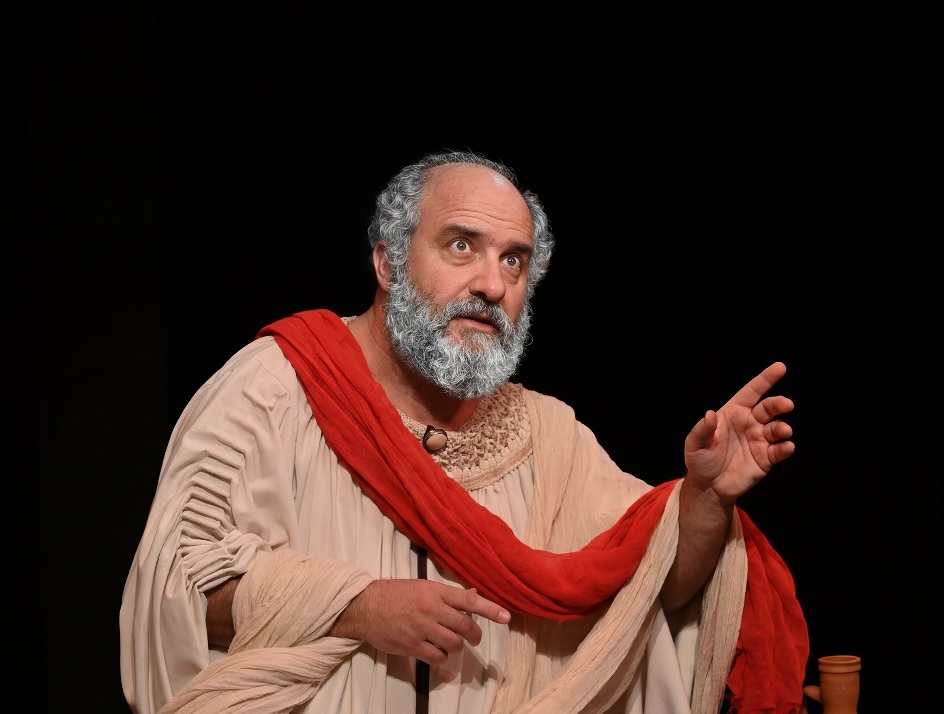
Watch a dramatic composition inspired by the structure and ethos of ancient Greek tragedy. Explore the life of Socrates and his relationship with his wife, Xanthippe, which carries both comic and tragic elements.
See encounters with his students through philosophical dialogues and scenes of domestic life. At a symposium, he meets Diotima, and their dialogue on the nature of love unfolds. Witness the climax of the play, which centers on his trial, imprisonment, and defense.
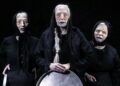
See the end of Socrates’ life as he drinks the hemlock. The Chorus, along with music and songs performed using ancient Greek instruments, functions as a fundamental element of tradition.
It comments, reflects, and accompanies the action, serving as the voice of conscience as well as of the City.
Director’s Note
In Socrates: My Life, I sought not to present a distant monument of philosophy, but a living, breathing human being—contradictory, provocative, tender, and unyielding. Socrates emerges here not only as a thinker of great clarity, but as a man deeply embedded in the rhythms of daily life: in dialogue, in conflict, in love, and in solitude.
The work draws its structural and emotional inspiration from ancient Greek tragedy. The presence of the Chorus, the musical landscape shaped by ancient instruments, and the ritualistic unfolding of the action are not mere aesthetic choices; they are an attempt to reconnect with a theatrical language where thought, poetry, and collective experience become one.
At the same time, the relationship between Socrates and Xanthippe grounds the play in an intimate reality. Their exchanges move between the comic and the painful, revealing the cost of a life devoted to inquiry. Philosophy here is not abstract—it enters the home, disrupts, provokes, and demands.
The encounter with Diotima stands as a moment of illumination. Through her voice, love is transformed from desire into a path toward truth and transcendence. This idea resonates throughout the play, guiding Socrates toward his final act.
The trial and death of Socrates are not treated as mere historical events, but as the culmination of an inner journey. His choice to drink the hemlock is not an end, but a passage—an ultimate affirmation of his commitment to truth, integrity, and the examined life.
This production invites the audience not simply to observe, but to participate: to question, to reflect, and perhaps to recognize themselves within the tension between the individual and the City, between belief and consequence.
Socrates does not offer answers. He leaves us with something far more demanding—the responsibility to ask.